Textbooks

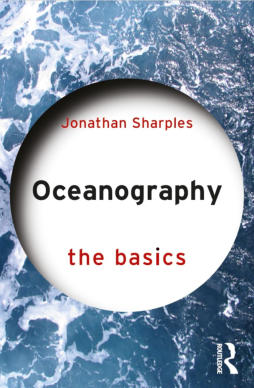
Sharples, J., Oceanography - the Basics. Routledge, 2026.
This book is aimed at year 1 undergraduates. It takes a
multidisciplinary approach to understanding how the ocean works,
using my own research and teaching interests to link ocean physics
through to the growth and distribution of plankton and how the ocean
plays a role in Earth’s climate.
Available here.
Contents:
Acknowledgements
1.
Introduction
2.
Temperature, Salinity, and Density
3.
The Plankton
4.
The Circulation of the Ocean
5.
Tides and Other Waves
6.
Global Patterns in Primary Production
7.
The Shelf Seas
8.
The Ocean and Earth’s Climate
9.
Measuring the Ocean
Glossary
References
Additional resources:
•
Additional reading.
•
Links to datasets.
•
End-of-chapter questions.
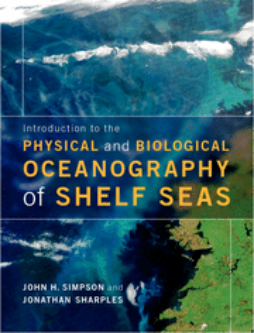
Simpson, J. H., and J. Sharples. An Introduction to the Physical
and Biological Oceanography of Shelf Seas. Cambridge
University Press, 2012.
This textbook describes the physical processes that operate in shelf
seas, and the effects that the physics has on shelf sea biology. It is
aimed at final year undergraduates and postgraduate students. The
book website provides additional resources, including numerical
models and samples of observational data.
Contents:
Preface
1.
Introduction to the shelf seas
2.
Physical forcing of the shelf seas: what drives the motion of
ocean?
3.
Response to forcing: the governing equations and some basic
solutions
4.
Waves, turbulent motions and mixing
5.
Life in the shelf seas
6.
Seasonal stratification and the spring bloom
7.
Interior mixing and phytoplankton survival in stratified
environments
8.
Tidal mixing fronts: their location, dynamics and biological
significance
9.
Regions of freshwater influence (ROFIs)
10.
The shelf edge system
11.
Future challenges in shelf seas
References
Index
Additional resources:
•
Matlab modules demonstrating key shelf sea physical
processes.
•
A 1-D (vertical) numerical model of shelf sea physics and the
response of the phytoplankton (Windows application).
•
All figures from the book.
•
Observational datasets and suggested student exercises.