Summary:
This EU MAST funded project was to study the
potential risk for scour in the vicinity of coastal
structures, and to prepare and disseminate practical
guidelines, to be developed from the research
programme and also taking into account all
"state-of-the-art" knowledge.
The project was divided into two sub-projects. In
the first sub-project, attention was primarily
concentrated on the water column with flow processes
and the resulting scour with some input from
sediment parameters. In the second sub-project,
processes associated with the sediment are the major
concern. The first sub-project basically consists of
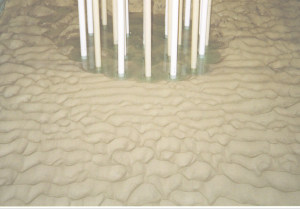
the following research themes: 1) Flow and scour
processes around vertical cylinders, simulating
individual piles or individual large cylinders (such
as platform legs, or bridge piers), or pile groups;
2) Flow and scour processes around breakwaters (such
as detached breakwaters and submerged breakwaters);
and 3) The effect of turbulence on sediment
transport/scour where the incorporation in the
sediment transport/scour calculations of the
turbulence generated by the structure itself is the
main focus of the study. Techniques to be used in
all the three research themes are mainly the
laboratory experiments, while the third theme
involves also some theoretical study.
The second sub-project, on the other hand, had
the following research themes: 1) Wave-generated
pore pressure and scour around breakwater element (a
field study where the wave generated pore pressure
and its association with scour around a cylindrical
shaped breakwater element is the major concern of
the investigation); 2) Non-linear modelling of
wave-induced pore pressure with the purpose of
studying the liquefaction initiation mechanisms in
relation to the loss of bearing capacity for small
objects on the seabed (such as armour blocks), and
also in relation to both the general scour and the
local scour processes; 3) Wave bottom pressures and
wave kinematics in the surf zone, two important flow
processes with regard to the generation of pore
pressures in the surf zone; 4) Sediment
transport/scour by accounting for the effect of
momentary liquefaction; 5) Penetration of blocks
into the seabed (in the absence of filters) due to
the reduction of soil stiffness caused by the
buildup of pore pressure under wave action; and
finally 6) Cyclic stiffness of loose sand at small
confining stresses. The first theme in this
sub-project involves a field study, while the other
themes involve theoretical studies, and laboratory
investigations.
The project was co-ordinated by Prof B. Mutlu
Sumer of ISVA DTU, Denmark.
Duration:
The duration of the Project was for 36 months,
starting from 1st Oct 1997
Funds:
The total funds for Liverpool was £47,425
under contract no MAS-3-CT97-0097
Further Details:
For details please visit the Project website:
http://www.isva.dtu.dk/scarcost/scarcost.html |